Redmond’s budgeting process involves input from staff, council and citizens
Published 3:56 pm Friday, June 1, 2012
With an Oct. 9 deadline, City of Redmond Mayor John Marchione and staff are already working to prepare a preliminary city budget to present to City Council.
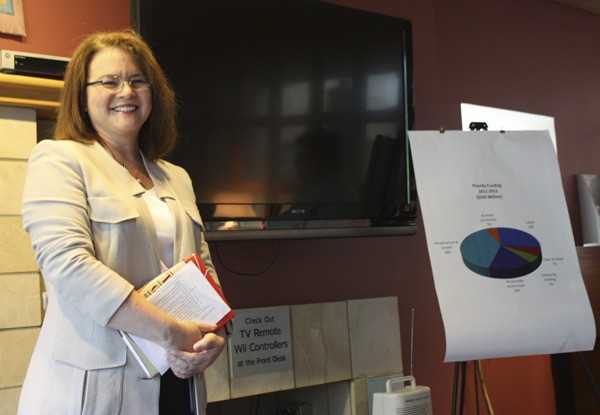
In the middle of it all is Malisa Files. As deputy finance director for the city, the 18-year Redmond resident is very involved in the city’s budgeting process and this year is no different.
On Friday, Files spoke at the Redmond Senior Center’s (RSC) First Friday Coffee Chat to give attendants some insight into the city’s Budgeting by Priorities (BP) process. This is the third time Redmond has used BP to prepare its biennial budget, which covers two years.
“We only prepare a budget every other year,” Files told the chat audience.
The current budget staff is preparing the city finances for 2013-14. Files said since they are still in the middle of preparing it, she can’t tell how much the upcoming two-year budget will be. The budget for 2011-12 was about $542 million (priority breakdown below).
 The mayor and city staff will present City Council with their preliminary budget on Oct. 9, but Files said staff keeps council members informed throughout the whole process.
“We keep Council informed all the way,” she said. “Our motto is ‘no surprises.'”
There will be one public hearing beforehand for community input on June 19 and two more hearings on Oct. 16 and Nov. 20. All three will be part of Council meetings, which begin at 7:30 p.m.
Once the budget is presented to Council, there will be study sessions on Oct. 25 and 30 and Nov. 1, 8, 13, 15, 27 and 29. More information will be provided closer to these dates.
Redmond City Council is scheduled to adopt the 2013-14 budget on Dec. 4.
Files said before switching to BP, the city — like many governments — used an incremental budgeting process. This is where the budget is increased or decreased by a certain percentage depending on how much money the city had lost or gained. Files said this process is not very involved and “not really satisfying.”
She said city staff have the opportunity to learn more about other departments through BP as the budget is broken down into priorities and more than one department can fall under a priority and a department can fall under more than one priority.
The six priorities are Infrastructure and Growth, Clean and Green Environment, Community Building, Safety, Business Community and Responsible Government.
“(BP) is one of the best budget systems I’ve ever seen…This process has a lot of things going for it,” said Files, who has worked for the City of Redmond since 1994.
Before coming to Redmond, Files worked in finance and budgeting in her home state of California for the cities of Pasadena and Upland.
Unlike incremental budgeting, she said BP is a very involved process that also includes a lot of citizen input.
The city held three Neighborhood Network meetings in February and March during which they asked residents about what issues and challenges they face in their neighborhoods and what short-term (1-6 years) and long-term (6-12 years) projects they feel are needed to address these issues.
In addition, the city has six results teams — one per priority — made up of citizens and city staff. These teams work to prioritize and rank city budget offers based on how they would contribute to their respective priorities as well as how well they align with the city’s vision.
Files said each team has four people, one or two of which are citizens. She added that they try to mix things up so city staff are on teams that are not connected to their departments. For example, they would not have someone from the fire or police department on the Safety team or someone from public works on the Infrastructure and Growth team. However with how involved BP is, Files said they also have to take into consideration who is available.
“It is very time intensive, no doubt about it,” she said.
Another part of BP is looking at performance metrics to measure how well the city is providing and delivering for its citizens. Files said they measure performance in the six priorities in different ways including community surveys, business longevity and diversity, emergency response times and maintenance report cards.