
AARP Washington kicks off financial planning events in Redmond
Published 2:33 pm Wednesday, April 17, 2013
Jeanne Grote has spent most of her life focused on the present.The semiretired Issaquah resident said a lot of her life has been about survival, especially in raising her children.
Now in her 60s, Grote wants to do a better job of planning for the future — specifically when it comes to finances.
“I think that we should’ve done better,” she said.
In an effort to learn more about how she can save for the future, Grote attended “Strengthening Your Financial Future,” an AARP Washington event at the Old Redmond Schoolhouse Community Center in downtown on Wednesday. Grote was one of about 135 people to attend the event, which offered tips and tools people could use to achieve their financial goals.
In addition, AARP Washington also released the results of a recent survey, “Not Making the Grade,” the organization conducted in January. AARP surveyed 1,000 boomers (ages 45-64) in Washington to see how financially prepared they are and how prepared they feel about their future.
Like Grote, the majority of respondents — 81 percent — wish they would have saved more for their retirement years. Most respondents — 56 percent — also admitted they are anxious about their financial future. The survey showed that at 64 percent, women are more anxious about the future, while 48 percent of men are anxious.
Other survey results showed that 24 percent of respondents said they have less than $25,000 in savings and 16 percent have less than $5,000. Respondents were also asked to grade themselves on how well they are preparing for retirement. At 52 percent, more than half gave themselves a “C” grade or lower. Twenty-one percent gave themselves a “D” or an “F.”
AARP Washington State Director Doug Shadel shared these results and more with attendees as part of his opening presentation at Wednesday’s event in Redmond. As he shared the survey results, attendees were asked to respond to the same questions on the spot, using polling devices that showed real-time results from the room. Some of the in-room results, such as how anxious people are about their futures, were similar to the statewide survey results. Other in-room results, such as how much people have saved for retirement, were very different.
During his presentation, Shadel discussed three barriers that make it difficult for people to save more and spend less: The need to focus on the present for survival; people’s limits of willpower, which affects their self-control and the marketplace and how many different products and how much advertising people are exposed to.
Shadel said one key strategy in overcoming these barriers in financial decision making is to set clear goals, adding that people should focus on the bigger goals first and not the little things.
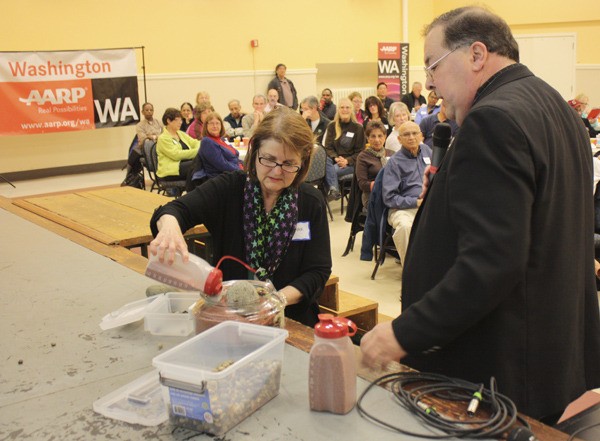
To illustrate his point, Shadel brought Grote up to the front for an exercise in which he asked her to fill a glass bowl with rocks from the size of a fist to grains of sand. The glass bowl represented her life while the rocks represented various goals.
During this exercise, Grote filled the bowl with the bigger fist-sized rocks first, which represented her “big-ticket” goals. Then came the gravel-sized rocks, which were the day-to-day goals such as getting up, eating breakfast and going to work. Finally, there was the sand, which represented the even smaller things such as answering phone calls and emails. Everything was able to fit in the glass bowl.
Shadel said if Grote went in the opposite order, the bigger rocks wouldn’t have fit. He said this reflects how people should approach life: focus on the big goals first.
“The rest of it will filter around,” he said.
AARP Washington’s event on Wednesday was the first of five “Strengthening Your Financial Future” events the organization will hold throughout the state through June. Upcoming events will be held in Seattle, Port Angeles, Spokane and Auburn. For more information, visit aarp.org/states/wa.