City plants trees at Sammamish Valley Park as part of mitigation work for Esterra Park
Published 11:40 am Wednesday, November 18, 2015
When developers began forming a plan for the old Group Health site in Redmond’s Overlake neighborhood, one of its requirements was that trees and shrubs be planted to mitigate those that were removed onsite.
Between 2013 and 2014, the City of Redmond has been planting this vegetation at various sites: Perrigo Park, Perrigo Heights and behind Swedish Medical Center, in the Bear-Evans Creek corridor near the old Keller Farm. The city had about 10 acres worth of trees and understory plant mitigation work, said Redmond park planning and cultural arts manager Carolyn Hope.
She said the mitigation work at Perrigo Park restored 1.7 acres with 570 trees and 5,356 shrubs; restoration at Perrigo Heights, south of Hartman Park, included 1.2 acres planted with 250 trees and 2,235 shrubs; and the Swedish site was the largest at 2.3 acres and included 774 trees and 7,183 shrubs.
Hope said the city has completed the work at those three sites — a total of 5.2 acres — and there is just one more site where work is being done before they have met the 10-acre requirement.
That site is Sammamish Valley Park and the future Redmond Central Connector (RCC) trail.

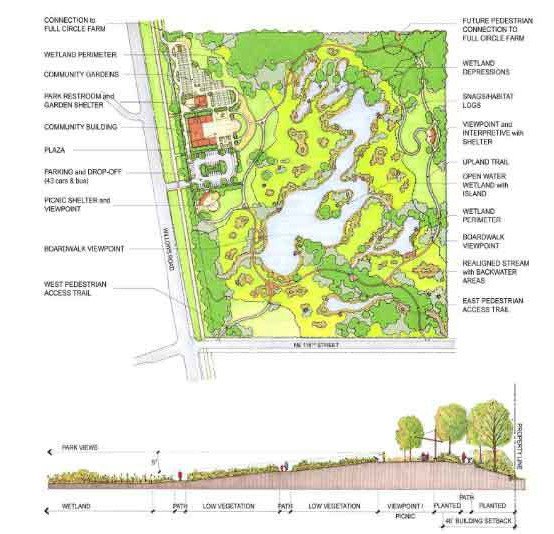
The tree-mitigation work at Sammamish Valley Park, a 28-acre city park at the northeast corner of Northeast 116th Street and Willows Road, began in September. Hope said the work at the park covers about 5.6 acres of property with 1,896 trees and 16,446 shrubs.
“This work will be completed this winter,” she said.
In addition to achieving the goals of the development agreement for the old Group Health site — now dubbed Esterra Park — in Overlake Village, a city press release states that the city and developer Capstone Partners are collaborating on this project to also achieve the goals of the Sammamish Valley Park Master Plan.
“We’re happy that something’s happening at the park,” Hope said.
She said this includes removing reed canarygrass, an invasive wetland plant, in areas where they are doing the mitigation work. The press release states that the work will take place “in the highest topographic areas of the site, which will allow the city to continue future wetland and stream mitigation work on the site.”
The city does not currently have funding dedicated to the rest of the park development, the release continues.
As previously reported, Capstone removed about 1,100 trees from the site to make way for the mixed-use development. Those previous reports state that the City of Redmond has an ordinance requiring new developments to retain at least 35 percent of trees onsite.
However, as Capstone has removed all of the trees onsite, Hope said they were required to do mitigation work at a 3-to-1 ratio. This means they have to plant three trees offsite for every one tree that was removed from the Group Health site.
She said the mitigation plan includes a three-tiered reforestation planting program and includes the planting of about 3,300 new native trees such as western red cedar, black cottonwood, red alder, vine maple, big maple and Douglas fir.
“The mitigation planting program also includes the planting of thousands of shrubs and ferns to develop a healthy understory for the replacement trees,” Hope said. “Examples of these understory plants include pacific ninebark, snowberry, salmonberry, flowering currant, and a variety of willows, wild rose, and ferns.”