
Former Guantanamo guard, Muslim convert speaks at MAPS in Redmond
Published 9:09 am Friday, March 25, 2016
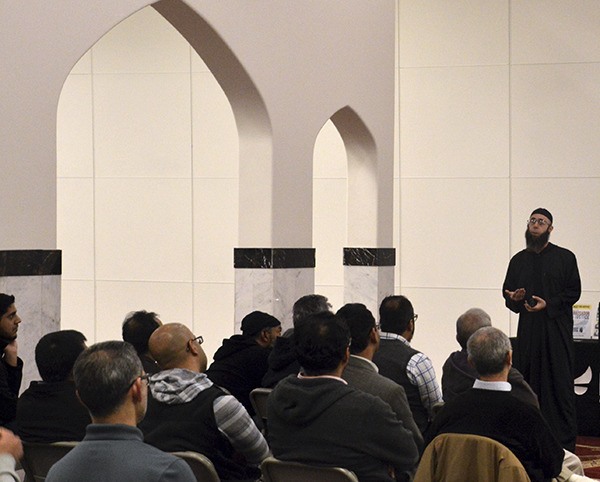
On the evening of March 18, after the penultimate prayer of the day, more than 60 people gathered in the prayer hall of the Muslim Association of Puget Sound (MAPS) in Redmond to hear a convert to Islam tell his story. This was no typical story of conversion. Before he became a Muslim, Terry Holdbrooks was a guard at the Guantanamo Bay detention camp.
Audience members sat, some in chairs but most on the carpeted floor of the expansive room as Holdbrooks, 32, told the story of his upbringing, his time at Guantanamo and what led to him joining Islam in 2004.
Holdbrooks was born in Phoenix, Ariz. in 1983 and initially raised in a home plagued by alcoholism and drug addiction. Starting at age 7, he was raised by his grandparents.
“About the time that I had turned 18, 9/11 had happened, I had no more money left for college and I wanted to do something more. I wanted to be somebody more….I wanted to change the name of Holdbrooks to a name that somebody could be proud of,” he said.
It was money, not patriotism or a sense of revenge for 9/11, that led to him going to a recruiter. But his motives were fairly simple.
“I want to kill people and get paid for it,” he told the recruiter. He was finally accepted after the fourth time he applied, and was stationed in Missouri briefly before being sent to Guantanamo.
Holdbrooks knew very little about Guantanamo — or about Islam or al-Qaida. He assumed the army would tell him what he needed to know.
“I figured the army would teach me about Islam — and they kind of did, in a very bad way,” he said.
Holdbrooks remembers his unit unexpectedly stopping off at Ground Zero before going to Guantanamo, and his commanders reminding the men to never be complacent.
“Remember the destruction and remember the rubble that you saw here,” Holdbrooks remembered them saying. “Remember the 3,000 innocent Americans that we lost here….Never forget what Islam did to us.”
When he arrived in Guantanamo and saw the prisoners, Holdbrooks was immediately skeptical the U.S. could have amassed more than 700 genuinely guilty terror suspects from around the world in such a short time. He was curious about the guards, and why they prayed so many times a day. He was surprised when the prisoners — supposedly dangerous terrorists — answered his questions so patiently.
Holdbrooks said the prisoners’ strong faith despite their circumstances was ultimately what led him to Islam. “I was led to Islam because the men whom I was torturing and abusing, as long as they could make their five prayers each day, they were happy.”
At the time, Holdbrooks was going through difficult experiences of his own.
“I still have a great deal of issue dealing with the things that I’ve done to people, I still feel bad about it, I still think of myself as a very low person,” he said of his time in Guantanamo. He was feeling suicidal, but his commander wouldn’t let him see a counselor, for fear that others would do the same.
One night, as he was walking past the cells, one of the detainees gave Holdbrooks a copy of the Qur’an. Holdbrooks stashed the book under his bed.
Over the next few days he read the book, and was transfixed.
“It was the first time in my life that I have ever read a religious book that has made sense. From the beginning to the end, the Qur’an made sense. It’s easy to follow, it’s concise, it’s like an instruction manual for living,” he said.
Holdbrooks gave up alcohol, and then smoking, each time feeling better. “Every change that I made to live as a Muslim would live felt good, made my life better,” he said.
He’d been practicing Islam for about two weeks when he took the step of conversion: the shahada, or declaration of faith. This, he said, was the most difficult thing about converting. The detainee he had befriended was Ahmed Errachidi, nicknamed The General (who was released from Guanatanamo without charge in 2007). Errachidi wrote out the shahada in transliterated Arabic on an index card and gave it to Holdbrooks, who spoke the words out loud, making him a Muslim.
“I think it was like the 18th time, I was finally able to say it properly,” Holdbrooks said.
That night, Holdbrooks thought about his life. Despite all his accomplishments, he felt something had always been missing.
“But after I said my shahada that night I was going to bed, I was much more comfortable. Because I knew the next day when I was going to wake up that I was going to start working on the same goal I was going to have for the rest of my life,” he said.
After converting, Holdbrooks faced physical and verbal altercations and threats from the men in his unit. A year later, before his unit was set to go to Iraq, Holdbrooks was given an honorable discharge.
In telling his story, Holdbrooks didn’t talk much about the politics of Guantanamo except to point to President Obama’s broken promise to close it.
“I can assure you that Guantanamo is never going to be closed,” he said.
Holdbrooks’s talk at MAPS was part of a 10-city tour around the country fundraising for the Muslim Legal Fund of America (MLFA), which offers legal defense to defend constitutional rights for Muslims in the U.S.
Khalil Meek, executive director of the MLFA, introduced the evening and Holdbrooks with a pledge to donate to the MLFA. Meek is himself a convert to Islam, and was once an aspiring Baptist preacher. He said Holdbrooks was invited to speak because his story is so unusual.
“People want to hear it, and they want to understand how their religion affected somebody who wasn’t Muslim,” Meek said. According to Meek, Holdbrooks’s story shows the power of simply practicing Islam — not preaching or talking about it — to change lives.
“Because he saw something that he didn’t have,” Meek said. “He said that all of the guards had all the freedom in the world…and they were all miserable. And people who had nothing and no freedom, no liberty, had only their religion and that was enough for them and they were happy. And that is a very powerful message for us to deliver to the Muslim community and to the world.”
Gulrez Khan, an attendee, agreed. He said Holdbrooks’s story showed the importance of practicing Islam and not worrying about negative media portrayals.
“I don’t know what those prisoners were, but from what we’ve heard they were just leading their normal life like the way every Muslim does,” Khan said.
Holdbrooks ended his talk with an affirmation of the power of faith in his life, and a call for unity among Muslims.
“Every minority in this country with the exception of the Muslims has had to go through what we are going through now. And the key to success is simple: we quit bickering amongst ourselves, we quit fighting amongst ourselves, we come together and we show the rest of the U.S., the rest of the world that there is nothing to be afraid of. Islam is not the enemy,” he said.
After he finished telling his story, Holdbrooks joined the rest of the gathering in the final prayers of the evening.
Chetanya Robinson is a University of Washington student.