An American Muslim woman’s experience at Trump’s first congressional address | Guest Column
Published 10:30 am Friday, March 10, 2017
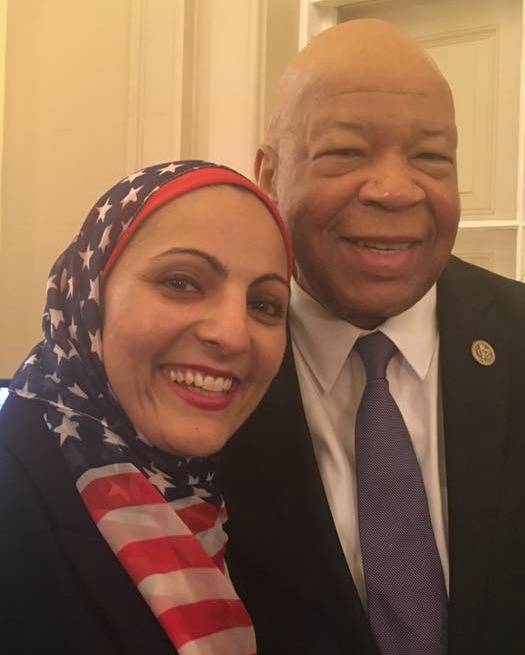
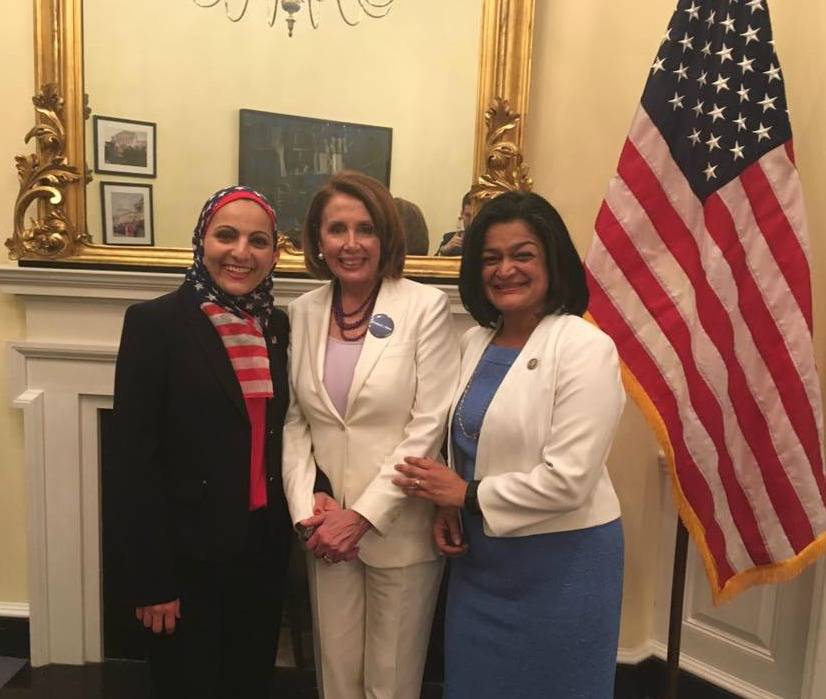
I am a proud American Muslim woman who attended President Donald Trump’s first speech to the joint session of Congress on Feb. 28, wearing an American-flag-themed hijab.
At a time when American Muslims, among other communities, are being demonized, I wanted to remind our fellow Americans that Muslims have been part of our country since the very beginning. That American Muslims participate actively in mainstream society and give back every day. That with other groups, American Muslims form the cultural diversity that is one of America’s greatest strengths. That American Muslims share the same American values and freedoms that we all cherish, knowing that we are all in this together. And that American Muslim children have the right to the same hopes and dreams as every other young American.
So how did I end up at the President’s address, and what did I experience?
The invitation to attend
On Feb. 7, I received an invitation from Congresswoman Pramila Jayapal (D-WA) to join as her guest to the state of the union-styled speech. Mixed emotions ran through me. On the one hand, I was honored and flattered to be invited by my representative, a woman I deeply admire and respect for her years of committed advocacy for justice on behalf of marginalized communities, and someone I am blessed to call a friend.
On the other hand, Trump’s rhetoric and policies targeting my fellow Americans including Muslims, people of color, children and families seeking refuge, the differently-abled, LGBTQ folks and women directly hurt me, my family and my friends. His words, proposals and actions attack our shared American values of religious freedom, equal protection under the law and a free and independent press, along with diversity and civil discourse. This hurts us all as Americans. I did not want to be there in person for any further attacks and demonization of my fellow Americans. So what to do?
I turned first to my Islamic faith, which teaches that one of the highest forms of spiritual struggle is to speak truth to power. Prophet Muhammad (peace be upon him) also taught us to act to address injustice if possible; but if not, to at least speak out against the injustice; and if we cannot do even that, to hate that injustice in our hearts. And the Quran commands us to “stand out firmly for justice, as witnesses to God” (Quran 4:135), and repeatedly instructs us on the virtues of patience through difficulties. So my religious obligations called me to speak out and act for justice, with courage, strength and patience.
I also thought about how my attendance could help showcase the diversity that actually makes our country great, educate our fellow Americans about the lives and contributions of American Muslims, and let politicians see members of the communities they are directly impacting with their policies and proposals.
In addition, I realized there was no way I could reject Rep. Jayapal’s invitation. If my congresswoman was willing to use her single guest pass to give voice to a member of a marginalized American community, how could I say no?
On Feb. 8, I accepted the invitation. Game on.
Preparing for the event
The news about being Rep. Jayapal’s guest was not to be public until the designated press release date of Feb. 23. On Feb. 22, Rep. Jayapal and I recorded a short video clip where she introduced me as her guest. The video and press release were issued the next day, amidst a flurry of activities before my scheduled departure to Washington, D.C.
I faced a critical question as I packed for the trip: what do I wear? Specifically, I wondered whether to wear my patriotic American-flag-themed hijab. I wore that hijab when I spoke at the Women’s March in Seattle, and received a lot of positive feedback. Wearing the American-flag-themed hijab would allow me to demonstrate once again that like millions of American Muslims across our nation, I am a proud American and a proud Muslim, and those two identities positively complement each other. It also would reinforce the message of “We the people are greater than fear” from the iconic image of Munira Ahmed in an American-flag-themed hijab in the Shepard Fairey poster released earlier this year.
But I did not want to attract more attention than I already would receive as a woman of color and a Muslim, nor did I want to suggest in any way that American Muslims have to visibly “prove” their patriotism. Plus, some find the wearing of American-flag-themed apparel to be disrespectful, even if that was far from my intention. (Some have no problem with other flag-themed clothing – whether it be T-shirts, bandanas or even bikinis, but find the wearing of a flag-themed hijab as inappropriate. I was not concerned about such anti-Muslim views.) I packed my American-flag-themed hijab, just in case, along with an entirely separate business formal outfit.
Press conference and reception before the speech
In Washington, D.C., Rep. Jim Langevin (D-R.I.) organized an afternoon press conference featuring different House Democrats who had invited guests from communities affected by the administration’s policies or proposals. American Muslims, Latino Americans and newly arrived Americans joined their representatives as they shared their powerful and moving stories, described their contributions to and love for our country and reflected the beauty of our country’s diversity.
Besides speaking about my own narrative, I highlighted the reality of American Muslims in my remarks. At a time when American Muslims are cast as outsiders, it is more important than ever for our fellow Americans to know that Muslims have been part of our shores since before we were an independent nation. Fifteen to 30 percent of slaves brought from Africa were Muslim. And American Muslims fought in our Revolutionary War, Civil War and every single war since then. Today, more than 10,000 American Muslims serve honorably in our nation’s defense forces, and many have even sacrificed their lives for our country. More than 50,000 American Muslim medical doctors, like my sister, are saving lives every day. Millions of American Muslims are nurses, firefighters, teachers, entrepreneurs, volunteers and neighbors, positively contributing to our communities every single day. American Muslims share the same American values and freedoms that we all cherish, knowing that we are all in this together.
The elected leaders at the press conference stood for the best of America as they spoke about diversity as a strength, unity as a bond and the ideals of justice for all. It was a positive, optimistic and inspiring event.
After the press conference, I decided to go ahead with the full patriotic look for the President’s speech, including my American-flag-themed hijab. I wanted to make clear that I am a proud American Muslim here to stay, that the diversity reflected at the press conference is part of what makes America beautiful, and that no one has a monopoly on what it means to “look” American or be patriotic.
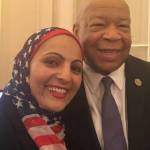
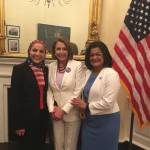
Right before the President’s speech, House Minority Leader Nancy Pelosi hosted a reception for representatives and their guests. Like the press conference, this event was welcoming, affirming and unifying. Many people positively commented on my American-flag-themed hijab and some (like Rep. Elijah Cummings, D-MD) even floored me with their request to take pictures with me instead of me with them!
Inside the gallery for the President’s speech
Inside the Chamber of Congress, members of the three branches of government (legislative, executive and judiciary) were seated on the main floor while all guests – including Trump’s own family members – were seated on the upper balcony. As guests attending the joint session of Congress, we were not allowed to have purses, bags, cell phones or much else with us inside the gallery. We had to be in our assigned seats more than 30 minutes before the scheduled start time. Nor would we be able to leave our seats (even for a restroom break) until after the President had left the building.
I was seated behind cameras on the balcony to the President’s left, near Melania and Ivanka Trump. Although I could not see President Trump, I had a direct view of the lower level. The politicians were divided in two. On one hand, you had the Republican majority of mostly white men in dark suits, interspersed with the occasional woman and occasional color (skin tone and outfits). On the Democrat side, you had many more women and people of color, including a noticeable group of Democrat women wearing white (in honor of the suffragist movement). You also had a few people, like Rep. Markwayne Mullin (R-OK) and Rep. Joe Kennedy (D-MA), crossing the aisle to sit together, perhaps to make a statement that Republicans and Democrats can cross party lines.
As I sat surrounded by strangers before the President’s speech, we exchanged pleasantries and got to know each other a bit, as we pointed out different politicians to each other. Then the President entered the chambers and began his speech. The entire day to that point was in stark contrast to what came next.
In the past, Trump had been openly fiery and divisive in some of his rhetoric. His speech to Congress definitely had a softened tone. But sadly, despite some beautiful words of unity, a message of fear-mongering and divisiveness remained. Two examples stood out the most to me.
First, while President Trump finally condemned the recent anti-Semitic attacks and hate-motivated shooting in Kansas, he failed to even acknowledge anti-Muslim hate crimes. This is despite the fact that anti-Muslim hate crimes have reached some of the highest levels in our nation’s history – in part because of the rhetoric, proposals and conspiracy theories advanced by politicians and commentators over the past decade. Moreover, anti-Semitism and Islamophobia have a very strong link, with anti-Semitism being the biggest predictor of someone being anti-Muslim (32 times more likely!). And the Indian-American man killed in Kansas was a victim of Islamophobia, as he was believed to be of Middle Eastern descent. We have further seen a tripling of anti-Muslim hate groups since 2015, and mosques have been vandalized, including my own mosque, the Muslim Association of Puget Sound, which had its sign destroyed twice in less than a month.
Rather than recognize and denounce such acts of hate and violence against Muslims in America, President Trump continued to target Islam and even misrepresented statistics on violence by foreign nationals in our country to justify proposals like his first unconstitutional Muslim ban. His claim was identified as false by fact-checkers.
The reality is that American Muslims have some of the lowest crime rates of any American religious group and American Muslims are more likely than any other American religious group to support peace and find no justification for violence. American Muslims support the Constitution of the United States and want to succeed in the traditional American way by working hard and educating their children. More facts can be found at www.islamfactcheck.org.
Spreading fear and conspiracy theories against an American minority is dangerous and divisive, and leads to hate crimes as we have seen. And Islamophobia hurts us all, as bigotry and hatred are like a fire that consumes our entire house and does not remain confined to just one room or one group.
Second, President Trump exploited the personal tragedies of his guests – victims of crimes allegedly committed by undocumented persons – to further spread xenophobia. He used cases that are anomalies to demonize newly arrived Americans, when in reality, immigrants commit far fewer crimes than native-born Americans. He also peddled this fear into a new office to keep track of crimes by immigrants, VOICE (Victims Of Immigration Crime Engagement). This proposal received audible boos in the chambers – and not only by Democrats. The cataloguing of crimes by undocumented Americans sounds eerily similar to the listing of Jewish crimes during Nazi Germany.
President Trump’s rhetoric and proposals, even if delivered in a softer tone and with some flowery language, are a threat to all Americans. The President should have used his first address to Congress and the American people as an opportunity to help unite our country on our shared American values of religious freedom, equal protection under the law, tolerance and diversity, recognizing that we are all in this together.
After the President’s speech
As an American Muslim, I left the President’s speech with emotional wounds. Those wounds were inflicted on my proud American identity by the multiple cuts to our shared American values and what makes our country great – including religious freedom, equal protection under the law and the beautiful bipartisan tradition of welcoming children and families seeking refuge in our nation, who in turn have made our country better. What bothered me most about the speech was the normalization of the rhetoric and proposals, and the thunderous applause President Trump received despite his misrepresentations and exploitation of real personal tragedies to stoke fear and promote divisive policies.
I had to go right into media interviews after the speech, without the time and opportunity to really digest what had happened or the benefit of fact-checkers on so many of President Trump’s statements. I also generally am an optimist and try to find the good in things. I tried to do that with the President’s speech, even in the media interviews. But it was a challenge. I don’t recall what I said in the media interviews.
Afterwards, I spent some time with Congresswoman Jayapal, and then spoke on the phone with other American Muslims who had attended the speech and generally shared my sentiments about the experience. I was not able to go to sleep until after 4 a.m. Later that morning, I joined a press conference with Define American, an immigrant rights organization where we stood united for the values of compassion, unity, truth, peace and justice for all.
Hearing media commentators fawn over the President’s speech was disturbing. In my mind, what makes someone presidential is the ability to courageously lead a nation forward during times of challenge, and to inspire us to be the best we can be as citizens and as a country. That is not what I heard or experienced at the joint session of Congress.
Some question how or why I nonetheless remain so patriotic and optimistic. It’s because I see the promise, potential and power of America and our fellow Americans. The ideal enshrined in our Declaration of Independence that “all men are created equal, that they are endowed by their Creator with certain unalienable Rights, that among these are Life, Liberty and the pursuit of Happiness.” The rights, freedoms and liberties guaranteed in our Constitution. The quote on the Statue of Liberty. The Latin motto “Out of many, one” on our Great Seal. The compassion and generosity of spirit of our fellow Americans. The opportunity to live the American dream, and the promise of justice for all in the land of the free and home of the brave. We may not be there yet with our nation’s ideals, but those are dreams and values worth fighting for, and those are the reasons I am proud to call myself American – even as I embrace my patriotic duty to “right the wrongs” in our country.
Wearing my patriotic outfit to represent American Muslims to millions of viewers turned out to be a positive way of making a statement, as a picture of me in my American-flag-themed hijab made it into the collection of 31 images by Reuters and the 17 photos in the Washington Post of the speech. Sometimes, you have to stand out to publicly and vocally represent your communities, especially when you are not allowed to speak, as was the case inside the gallery.
On my flight back home to Washington state, I watched the movie “Selma,” to remind myself of the civil rights struggle and get inspired by the leadership and resilience shown by our predecessors in the fight for justice. As Martin Luther King, Jr. said: “Our lives begin to end the day we become silent about things that matter.” Now is not the time to be silent. Now is the time to be vocal about our faith and moral values, our personal principles, our cherished American ideals. These are defining times in our nation. History and God will judge us for our actions – or failure to act.
My key takeaway from my D.C. trip is that there are competing visions of America, captured in my personal experience of the events on the day of the President’s speech.
One vision is that celebrated at the afternoon press conference and reception, where we stood together as Americans who love our country – to make sure we do not target people based on religion, race or other. We protect and uplift each other instead, recognizing we are all in this together and our strength comes from our unity and cooperation. And we affirm that all of us are better off when each of us is better off.
The second is a dark vision of fear and divisiveness reminiscent of other dark chapters in history, where facts are manipulated to create alternative realities and rhetoric and policies lead to hate and violence. This second vision might cloak itself under some of the beautiful rhetoric of the first vision, but it propagates a very different reality that demonizes and scapegoats minority communities. Even if the immediate victims might come from those marginalized groups, such a fear-driven atmosphere hurts us all as Americans.
These competing visions do not fall along a Democrat/Republican or liberal/conservative divide. They are a reflection of who we are as a country, as a people and as individuals. My patriotism, Islamic faith and personal values mandate that I fight for the first vision and remain hopeful and optimistic as I struggle for peace, equality, unity and justice for all. Standing for these values is not easy. Fear, on the other hand, is easy and exploitable, and demagoguery is powerful and more dangerous than we can imagine.
I invite all Americans of good conscience to join me in action and solidarity as we struggle for the soul of our country and pursue facts over fiction, courage and faith over fear, and love and compassion over hate, so we can be the United States of America, one nation under God, indivisible with liberty and justice for all.
Learn more about how you can get involved by following the MAPS AMEN Facebook page or the Faith Action Network.
Aneelah Afzali is founder and executive director of the American Muslim Empowerment Network (AMEN), a new initiative of the Muslim Association of Puget Sound (MAPS) in Redmond. She is also a board member of the Faith Action Network, and a graduate of Harvard Law School.