A behind-the-scenes look at Cavalia’s horse-led production
Published 9:56 am Monday, January 30, 2012
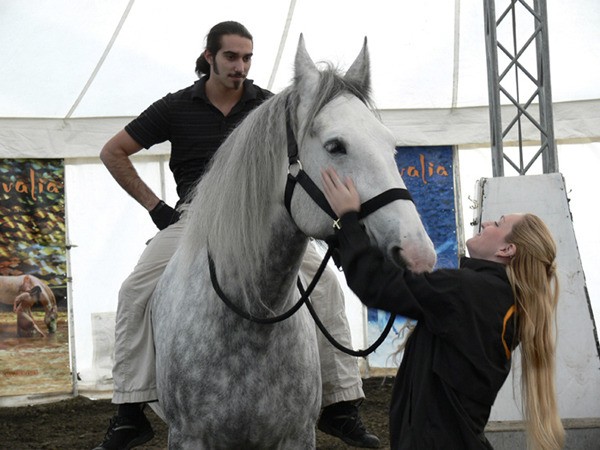
The age-old theater question: How do you keep it fresh after the 800th show? Answer: You give a horse the lead.
The extravaganza known as “Cavalia: A Magical Encounter Between Man and Horse,” which runs through Feb. 19 under the White Big Top at Marymoor Park, is theater on a grand scale with the horse as lead. Watching horses express their creativity is captivating every time.

Awe and wonder are evoked as horses interact with humans divulging the enigmatic, symbiotic relationship they share. The scene is particularly engaging when the horse is encouraged to explore his own agenda. No one can be certain what the horse will choose to do, not even his supporting cast.
The production uses a variety of means to reveal the mind of the horses with and without humans. From the freedom of “liberty” training where the horse works naked, purely from vocal and visual communication, to the discipline and elegance of Grand Prix level dressage (Equine Ballet). Nine-month old foals (kindergarten) get their time on stage without human supervision while later in the show, seasoned trick riders ramp up the excitement on their four-legged roadsters. Peppered in are an array of aerialists and acrobats flying and flipping while highly educated equines trip the light fantastic.
The horse/human relationship is steeped in mystery and paradox giving the show its fascination. Horses are designed to run away from threats, such as people flying at and around them. But their generous nature propels them to overcome their fear and instead, agree to do something inconceivable for a prey animal. Cavalia allows us to witness what magnanimous beings horses are and to what extent they will overcome their genetic coding to give what we ask of them.
Human consideration of the horse has evolved from when the horse was used as an instrument to build human society, defeat our enemies and conquer territories. We now regard our horses as members of our families whose health and wellbeing we fret over. The work to care for them may be long and arduous, but the investment is returned multiple times over in their generosity and camaraderie.
LOVE AND RESPECT
Speaking to the artists and crew of Cavalia you hear repeatedly how, when you love and respect the horses, they will grant your dreams. Which is what music director Sylvain Gagnon, 34, from Montreal, said when I asked him what he wanted people to know about the show? “I don’t want people to know, I want people to dream.”

Getting the music right for a show where the star is an animal requires a hat trick. It must work for the horses, the riders and the musicians. The singer and five musicians (cello, drum, bass, guitar, and keyboard), who are creatively worked into the backdrop images, watch the horses on monitors as well as the stage adjusting the music as needed.
“Normally the musicians follow the music sheet but here,” Gagnon laughed, “it’s the horse.” He has learned to read the horses very well and knows how to adapt the music to fit the action. “When you’re used to it, you can know just by looking, you see the attitude of the horse.”
Gagnon said he never stops talking to the musicians during a performance.
“In a normal show with no horses, we don’t need so many cues; a cue to the singer, a cue to start and stop the music. But here it’s nonstop cues.”
Cavalia has replaced the antiquated philosophy of domination over the horse with understanding the horse on his terms through communication. Fostering a deeper understanding with each horse builds the dynamic relationships required for enticing performances. Those profound relationships, everyone with Cavalia will tell you, are manifested through service to the horse.
Directrice des Ecuries (stable director) Katherine Logan, 45, said, “With Cavalia, the number one thing is that the horses are happy. They’re comfortable and well treated on an individual basis.”
Retirement is more likely due to emotional stress than injury.
“If they see the horses are not happy doing what they are doing anymore, they get retired,” she said. “To me, that’s the ultimate horse people, that know these animals have feelings. They need to be respected.”
LABOR OF LOVE
Logan, with her wavy red hair and a ready laugh, told me chuckling, that she gets, maybe, one day a month when she can get away from her Blackberry and laptop to have an honest day off. But Logan isn’t complaining. A former barn manager for elite Canadian racing farms as well as an international Thoroughbred bloodstock agent, Logan loves her Cavalia job.

Horse service is demanding and the pay may be meager but it is a passion. Cavalia farrier (horse shoer), David Gingras, 32, from Quebec City, cited Roman and trick rider, Fairland Ferguson, as an example of the consummate horse servant. He said she is always paying attention to the horses she partners with, giving them whatever they need or want.
“That’s the kind of relationship that I like to see for somebody with horses,” Gingras said.
Gingras, whose striking blue eyes peered out from under his construction hard hat, lives in his mobile camper on site while the others enjoy nearby apartments. He commented on why humans love to serve horses — “because, it’s a pretty cool relationship.”
He fell in love with the craft of horse shoeing, he told me, the first time he saw a farrier at work, when he was 18. Prior to working with Cavalia he worked as a racetrack shoer. His mentor had seen the show and spoke to the stable manger who informed him they were looking for a new shoer. Gingras got the job of a lifetime.
He spoke about the unique opportunity Cavalia has given him as a farrier to expand his knowledge. Shoers don’t often get the opportunity for extensive travel but Gingras travels the world with Cavalia, meeting shoers in every city they visit. His favorite travel experience so far was accompanying the horses in flight to Europe.
In addition to meeting other farriers in new cities, Gingras, who calls himself a country boy, looks for country music venues where he can go line dancing.
The first thing you notice when talking with Ferguson, a South Carolinian, is how fast this 28-year-old southerner speaks. Is it a side effect from the speed of trick riding? You can’t miss her big smile and fiery red hair which matches the tails of her equine partners as they fly across the stage.
“I’m kinda a ham for attention,” she said of her performance.
She learned trick and Roman riding while studying biology at Coastal Carolina University. Her plan was to train whales at Sea World but a friend, who was working for Cavalia, encouraged her to audition for the show. She’s been trick riding for five years and loves it.
HAPPY HORSES
Ferguson stressed the importance of the humans’ responsibility to the horses.
“Yes, some of them understand performing and they love the attention and the applause. But, ultimately,” she said, “at night they don’t get a paycheck so their good health and the care for them, our love for them, that is their reward and we should never forget that.”
The horses and riders are carefully matched according to personality, Ferguson said. Everything she does with each horse is special. Her horses love and appreciate her, she said, and the feeling is mutual.
“I’m really blessed, couldn’t have a better job,” she said.
Ferguson told me each of her equine partners has a unique personality. One takes a lot of patience and understanding and is more likely to be subdued. Whereas, “Cisco” a handsome Paint, “is all over you all the time. He always wants to be touched and petted. She added that “Amaretto, is also very affectionate.”
For the love of the horse. Horse work is a relentless master but the rewards transcend convention. Every member of the 120-person Cavalia team is genuinely grateful and happy. Logan was hired within two weeks of answering the ad. She said it turned her life upside down but she hasn’t looked back.
“I’m very, very, happy,” she said.
The essence of Cavalia is to show horses who are happy at their work. There is nothing quite so alluring as watching a horse who wants center stage.
Lezlie Wolff writes for the Washington Thoroughbred Magazine and also does freelance writing for other publications.