Building a vegetable garden can be fun — and healthy
Published 12:52 pm Friday, April 16, 2010
Vegetable gardening doesn’t have to be tedious or a chore.
And, when you grow the vegetables yourself, you know whether pesticides have been sprayed on them and can rest assured that you aren’t ingesting chemicals. Plus, if you include your children, they will be more inclined to eat what they grow.
Here in the Pacific Northwest, we have been blessed with some odd mixtures of soil. There is gravel till further north, clay soil here in the Eastside region and more sandy soil in the Mercer Island area.
However you slice it, there is not enough organic matter which adds nutrients and creates friable soil for vegetable gardening. Vegetables are “heavy feeders,” or they require more nutrients to produce crops. And, they require good drainage so their roots are not sitting in saturated soil leading to stem rot.
Raised beds are the solution. By building a 24-inch tall structure that lasts, gardening can continue worry-free for many years. Here are some materials suggestions.
• Cedar: Cedar is naturally insect-resistant. If you choose to vegetable garden for only a few years, it’s a good choice. With our rainy winters, cedar will eventually decompose. It will last about 5-9 years depending upon weather patterns.
• Concrete block: Not only are they affordable, but they can be faced or stained if you don’t like the way they look. They can also be capped, producing a wall that is almost wide enough to sit on. Remember to fill the cavities with gravel so they don’t shift.
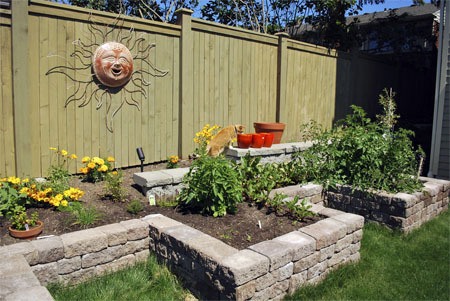
• Concrete pavers: Still affordable, these interlocking pavers (seen in photo) make attractive walls that last many years and will add to the value of your home. They can be capped and come in several colors.
• Steel or aluminum sheeting: Steel and aluminum sheeting are not as expensive as you may think and can be bent into flowing shapes. Supported by rebar, they go in quickly.
• Starting seedlings: If you are growing cool weather crops, you may consider planting carrots, radishes, kale and chard in February. This has been an unseasonably warm month, but we are still getting frost, so cover the crops at night. Otherwise, start your seedlings indoors in mid-March. Use a sterilized soilless mix to keep soil-borne diseases at bay. A heating pad can facilitate for speedy, reliable starts especially if you keep your home on the cool side. Seedling heat pads can be obtained through Growers Supply online. A 9” x 18” pad will be large enough to start 18 4-inch pots which can hold three or four seedlings. Keep your seeds damp until seeds are germinated.
• Pay attention to watering: After your seedlings have come up, water when the top 1/4 inch of the soil is dry. You do not want to promote damping off, a fungal soil-borne/seed-borne disease that causes the crown (stem base) of your seedling to rot.
When the first set of true leaves unfurl, it is time to transplant your seedings into larger pots. Place one plant per pot. At this point, you can transplant your crop and start a new batch of seedlings with the heating pad. If you have seedlings for lettuce planted every two to three weeks, you will have carrots, radishes and lettuce through out the season.
I used to work in stained glass, and a tool I used there called a “fid” is the perfect transplant tool for seedlings. By holding on to one leaf of the true leaves, I could lift the new roots out easily using the fid as a small spade.
• Hardening off: Before planting outdoors, plants have to get used to the cooler temperatures. Move your seedlings to a protected but unheated place like a garage or shed for the evenings and return to their sunny window for the daytime. If you start hardening off May 1, by May 15 they will be ready for the outdoor bed.
• Planting outdoors: Plant outdoors after the last hint of frost has vanished, usually around May 15th in our area. Have your soil ready to go, with a ratio of 50 percent compost added to 50 percent 3-way mix. To be sure they don’t get frosted, cover with Reemay each night until night time temps do not go back into the 30s or low 40s.
Nancy Tom of Down-to-Earth Garden Inc. is an Environmental Horticulturist. For more information, visit downtoearthgardens.com or call (425) 736-0420. Tom is teaching gardening classes at the Redmond Senior Center. For more information, call (425) 556-2314 to register.