Redmond native takes students around the world with Semester at Sea
Published 11:48 am Tuesday, October 29, 2013
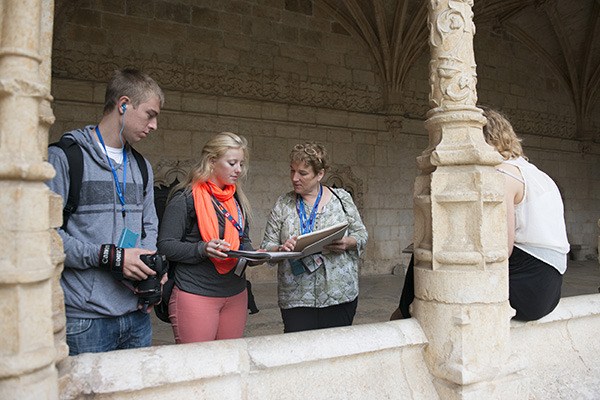
As an associate art professor at Elon University in North Carolina, Anne Simpkins is not new to traveling to other countries with students.
She has taught fine arts in study abroad programs in London and Italy for many years but this year, the Redmond native is adding a few more stamps to her passport. Through the Semester at Sea (SAS) program at the University of Virginia (UVa), Simpkins and her students have been traveling since August, visiting countries in Europe, Africa and South America.
“It sounded like a terrific way to see many parts of the world and to take my two daughters with me while traveling and teaching,” she said about why she applied to teach with SAS. “Elon University graciously gave me a leave of absence for this term.”
FROM REDMOND TO BEYOND
Although she currently lives in Burlington, N.C., Simpkins grew up in Redmond. She attended Redmond Elementary, Rose Hill Junior High and Lake Washington High schools, graduating in 1978. Her family still lives in the area.
This term, SAS is taking place on the MV Explorer — a large cruise-style ship with a shipboard community of 580 students and 120 faculty and university staff on board. The ship is scheduled to visit 17 cities in 15 countries in the span of 115 days. Students come from schools all over the United States as well as a few international schools to participate in the four-month program, which ends in mid-December. The program has completed its travels through Europe, which included stops in Germany, Belgium, Ireland and Spain. After that, Simpkins said they headed to Africa, with visits in Ghana and Namibia, before going to South Africa.
“(On) Nov. 1 we will cross the Atlantic and come up the coast of South America (visiting Argentina and Brazil),” she said. “Our last international port will be Cuba.”
Oct. 22 marked the 50th anniversary of SAS’s first voyage. Back then, the program was called the University of the Seven Seas.
Lauren Judge, director of public affairs for SAS, said one of the program’s founders, C.Y. Tung, had the vision that ships could carry more than cargo, they could carry ideas.
NOT YOUR TYPICAL CLASSROOM EXPERIENCE

Simpkins teaches two sections through SAS: Painting at Sea and Mixed Media Visual Journal.
“Each class group has about 18 students,” she said. “We meet whenever the ship is not in port.”
Simpkins said her mixed media course combines journal writing with sketches, collage and paint, to create student journals. The students try out various media options or experiment with a writing prompt. They also have short assignments in port such as having locals to tell them a traditional story. Students then create a journal page that illustrates and includes portions (or all) of the story text.
“Class time is short,” Simpkins said. “There are not a lot of places to work on art projects on the ship. But my students are still making art…Art classes direct students to respond to visual culture. My students and I create artworks that are inspired by the countries we visit.”
Simpkins and her students create art based on themes such as food, clothing, customs, shipboard life and traditional narratives or history.
She added that in holding class on a ship may lead to interruptions due to heavy seas, seasickness or a whale sighting. However, Simpkins said, “travel brings a rich mix of experiences and subjects from which to make art.” She said travel broadens the educational experience to understanding not just a home country but also the diverse cultures of the world.
Judge said the program is open to students of all majors and emphasizes “comparative academic examination, hands-on field experiences and meaningful engagement in the global community.” The program offers coursework from 20-25 disciplines, which is integrated with relevant field studies in up to a dozen countries.
“The University of Virginia is the program’s academic sponsor, which means that all courses on board the ship are accredited by UVa, and credit earned is transferable to a student’s home institution,” she said.
While UVa is the academic sponsor, Judge said faculty, staff and students from institutions worldwide apply to be part of the program. The program’s fall 2013 students represent 20 different countries from around the world and students from 250-300 colleges in the United States and the world participate each term.
ADDITIONAL EXPERIENCES

Students and faculty with SAS are generally free to explore each port and travel inland or participate in program tours or projects.
While in Ghana, Simpkins was part of a group that traveled to the small town of Winneba to distribute books to the local schoolchildren.
“The schools we visited had almost no books…They had no electricity or running water,” she said. “Class size was about 40 kids a room. Desks were a plank 12 inches deep, set on a small stand. Desks were shared by three kids.”
Simpkins said her two middle school-aged daughters were popular among the Ghanaian students as they read to the other children, told stories about their travels and shared what it is like to attend school in the United States.
While teaching and learning at sea offers a rare opportunity for participants, Simpkins said it does have its challenges.
“Our biggest challenge is contact with the world,” she said. “Internet works very sporadically. Cell phones work but are very expensive.”