Redmond residents visit recycling center on Earth Day
Published 11:42 am Wednesday, April 24, 2013
The first-ever Earth Day was observed April 22, 1970, with the goal of raising public awareness of air and water pollution and the importance of environmental protection.
Forty-three years later, this effort continues with the focus expanding to include other aspects of environmental stewardship such as recycling, clean energy and fighting global warming.
A LEARNING PROCESS
To do their part in helping protect the environment, a group of Redmond residents spent part of their Earth Day visiting Waste Management’s Cascade Recycling Center (CRC) in Woodinville to learn more about what happens to things after the collection truck sets their bins back down on the curb.
Aparna Varadharajan has always been curious about this and so she signed her family up for the CRC tour as soon as she learned about the opportunity. The Redmond resident said they had already visited the Cedar Hills Regional Landfill in Maple Valley and wanted to learn about the other side of the process.
Varadharajan said if people were able to see and understand what happens to their recyclables, they would be more likely to participate.
City of Redmond recycling coordinator Stacey Auer agreed.
The CRC tour Varadharajan and 40 other Redmond residents went on was the result of a partnership between the city and Waste Management. Auer said the goal was to inform residents about what can and cannot be recycled, and why, as well as where their recycling goes locally, how it is sorted and where it ultimately ends up being recycled.
“We hope this information will inspire citizens to recycle even more and to put items in their proper bins, recycling, yard waste or garbage,” she said.
AN OVERWHELMING RESPONSE

The CRC tour was advertised in Redmond’s newsletter, Focus, and Auer said the response was so overwhelming that they had to add two more tours to accommodate the numbers.
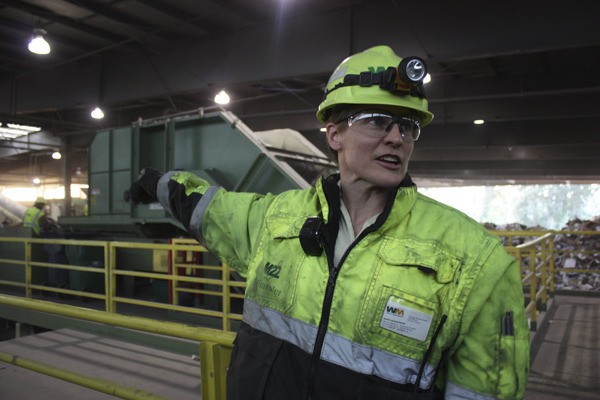
Kristin Kinder (above), education and outreach coordinator for Waste Management, leads these tours and said in the past, their audience has included educational groups such as local Boy Scout troops and classes on field trips. Monday’s tour was one of the first times the CRC has hosted a tour open to the public and Kinder admitted she was nervous that no one would sign up, but was then surprised with how many people were interested. The original plan was to cap the tour at 30 but after receiving more than 100 inquiries, they decided to add two more tours, which will be May 7 and 22. Both tours will begin at 6:30 p.m.
“It was really awesome to see the response,” Kinder said.
Auer added that they are considering offering the tours again in the fall.
“We are delighted Redmond residents are so interested in the recycling process,” she said. “Redmond is already a city of great recyclers and we are confident events like this one will help us be even better at keeping our city clean and green.”
EDUCATING THE NEXT GENERATION
In addition to the number of people interested in the tours, Kinder said she was also surprised with who was interested. She expected mostly adults but said 30-40 of the inquiries were from people like Varadharajan who wanted to bring their families. During the first tour on Monday, she said there were 20 adults and 21 kids.
While this was unexpected, it was not unwelcome.
Kinder is a firm believer in educating all ages — even the youngsters. And she speaks from personal experience.
“I can trace my passion for the environment to my kindergarten teacher,” said Kinder, who is now 28. “So for me, it’s not too young to educate them.”
Varadharajan agreed. She and her husband brought their 5-year-old son Tanmay Kulkarni, who helps with the recycling at home, on the tour as well. She said it is important to start young because it creates lifelong habits.”
You catch them young, you’ve got them,” she said. “It’s good for him to understand because if these kids don’t get it, we’re all in trouble.”
WHAT CAN BE RECYCLED IN REDMOND?
- Clean paper and newspaper such as newspaper inserts, mail and envelops, magazines and ice cream containers.
- Flattened cardboard, up to 2 feet by 3 feet.
- Glass jars and bottles, emptied and rinsed; no lids or caps.
- Cans and foil, empty and rinsed; no lids.
- Plastic bottles, jugs cups tubs and bags, emptied and rinsed; no lids or caps.
- Scrap metal, smaller than 2 feet long and 35 pounds; no wood, plastic or rubber attachments or casings. No sharp metal or greasy metal parts accepted.
To learn more, visit wmnorthwest.com/redmond.