Redmond Middle’s Sverrisdottir cracks the code for having fun, achieving success
Published 3:15 pm Thursday, November 21, 2013
For the past few years, much of Olina Sverrisdottir’s life has been spent in front of a computer screen.
She worked as a teacher’s assistant for Skema, an Icelandic company focused on incorporating computer programming and coding into the education system, for about three years. In 2012, she won first place in a competition put on by the FBI-SOS (Safe Online Surfing) program and Alice Project at Carnegie Mellon University (CMU) for creating a video about Internet safety. She was also a runner up in a European Centre for Women and Technology (ECWT) competition this year, which focused on inspiring girls and women to get involved in the tech industry. In addition, she was recently asked to make an appearance at a women’s conference in Europe as the keynote speaker — though scheduling conflicts prevented her from attending.
And she has achieved all of this by the time she reached her teens.
Recently transplanted from Iceland to Redmond, 13-year-old Olina is now a seventh-grader at Redmond Middle School.
She was first introduced to computer programming and coding when she was 9. Her mother, Rakel Solvadottir, was starting Skema — which teaches children how to code through a methodology supported by research in psychology, pedagogy and computer science — and Olina and her brother became students in the program.
“I saw (what programming was) and I thought it sounded really cool…turns out, it was really fun,” Olina said.
She said she likes coding because she can create her own world.
“Being able to do whatever you want,” she said about her favorite thing about coding. “Nothing’s wrong. There’s no wrong answer.”
Olina and her family moved to Redmond in August and Solvadottir is currently working to start reKode Education, a program like Skema, in Redmond.
After about a year with Skema, Olina became a teacher’s assistant at the age of 10, helping students and teachers learn the fundamentals of programming. The students Olina taught ranged from 6-16 and she said it was especially fun to teach the older kids — although, they may not have seen it that way.
“I think it’s kind of awkward that they’re learning from a younger person,” she said, adding that most of the teens eventually get over the awkwardness.
Olina said she also enjoys working with the teachers, as well, because they’re usually the “boss” and in charge and when she’s helping them, the roles are reversed.
“They kind of struggle more than the kids,” she said. “It’s kind of fun to see them do it.”
Olina’s love for coding has led her to participate in competitions geared toward young people. Her mother, Solvadottir, said the FBI-SOS and CMU competition — the Alice Animation Challenge — was focused on encouraging young people to create programs for their peers, illustrating safety guidelines for the Internet. Olina won the middle school division for fifth- through eighth-graders.
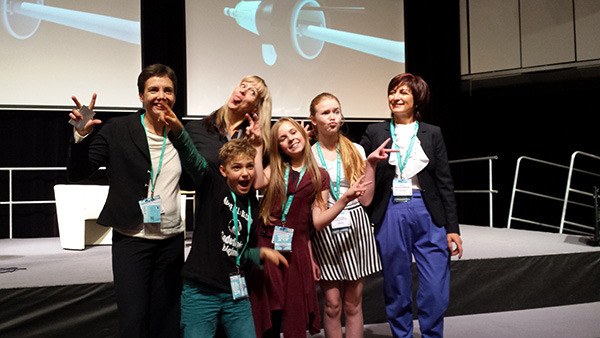
The ECWT competition in which Olina was a runner up was the European Digital Girl of the Year award in the 11-14-year-old category. The competition — which also has awards for Digital Girl (10 years and younger), Digital Woman and Digital Impact Organization of the year — highlights women, girls and organizations who make an impact in the digital world and inspire girls and women to get involved in the industry.
“It’s awesome,” Solvadottir said about Olina being recognized in the competition as well as her other achievements. “It couldn’t make me more proud.”
Solvadottir also noted that her daughter is “really girly,” enjoys dressing up and dancing.
“She’s not the stereotype,” she said, referring to the typical visual of a “nerdy girl” in glasses.
Solvadottir said it is important for there to be a lot of different types of role models for girls to look up to as they are more likely to find someone they can relate to. In addition, as a woman in tech, she said it is important to have more women in the industry because the two genders are different and each one brings different experiences and visions to the table. The industry needs both of these, Solvadottir said.