Washington STEM Summit at Microsoft features host of female speakers
Published 4:35 pm Thursday, December 3, 2015
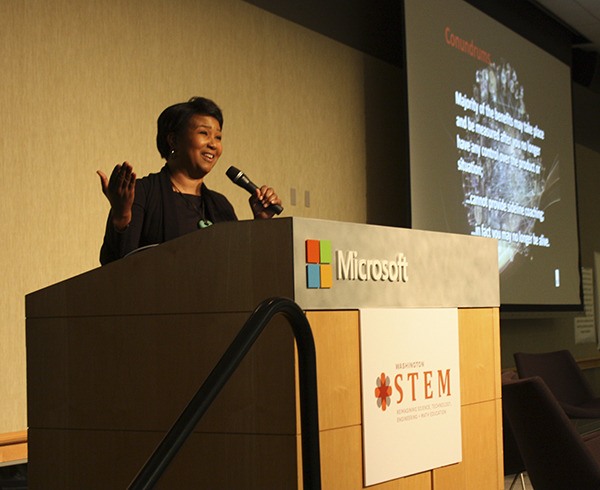
Educators, business leaders and others gathered at the Microsoft Conference Center in Redmond on Tuesday to discuss the future of the state’s science, technology, engineering and mathematics (STEM) education.
The event was a summit put on by Washington STEM, an organization founded to reimagine and revitalize STEM education for every student in the state. According to its website, the organization is doing this by driving innovation and improvement in STEM education.
One of the focuses of Tuesday’s event was girls and women in STEM as a number of female speakers were featured throughout the day.
One of those speakers was Dr. Mae Jemison, a former NASA astronaut and the first black woman in space.
She spoke during a STEM leadership breakfast and was featured as a keynote speaker later that morning, addressing all attendees.
STRONG SUPPORT SYSTEMS
Jemison discussed a bit about how she got into the field. She told her audiences that going into space was a foregone conclusion.
“I never had any doubts,” she said.
There were a number of other science fields she was interested in as a girl, but it always came back to outer space.
She didn’t receive much push back from her family and others close to her, but as a young black woman who grew up in the 1960s and 1970s, she was aware of the racism as well as sexism of the times. Jemison said she just did not experience it directly.
Despite the era she grew up in, Jemison said in some ways, it is more difficult for girls to go into STEM fields now because there is more emphasis on looks. If a girl is worried about how she looks, she is not likely to be going outside playing, making mud pies or anything like that, Jemison said.
“It’s something adults are doing,” she said about this type of attitude.
DIVERSITY AND ENCOURAGING YOUTH
During her speeches, Jemison also discussed some of the things she feels need to be done in order to encourage young people’s — girls’ and boys’ — interests in STEM fields. One of the terms she used was science literacy, meaning everyone will need to have at least a basic comprehension of science even if they do not go into a related field.

Ana Mari Cauce, president of the University of Washington (UW), agreed. She said people need to have basic science and numerical literacy in order to just be citizens of the world.
Cauce, along with Peggy Johnson, executive vice president for Microsoft’s business development division, was also a featured speaker, participating in a question-and-answer session with Washington STEM CEO Patrick D’Amelio. The trio covered a number of topics, including the importance of diversity on campus and in the workplace.
Cauce said not only is encouraging people of all backgrounds to enter STEM fields the right thing to do, she said they are going to need all the talent out there to remain competitive in the world.
When discussing diversity in the workplace, Johnson recalled her early days at Qualcomm — the company where she worked prior to coming to Microsoft. She said when she started, there were only a few female engineers and she was even told at one point to “be one of the guys.” Some of the suggestions people made to her included speaking up more, being more aggressive and pounding the table.
“I tried that,” Johnson said. “It was horrible.”
She said she felt very inauthentic because that wasn’t her personality. However, these were some of the characteristics employees were rated on, so Johnson and another colleague worked with the company’s human resources department to revamp their evaluations system. She said this shifted how they looked at hiring and promoting.
Johnson said now at Microsoft, diversity is something they discuss on a regular basis but acknowledges that they are not where they should be yet.
Johnson admitted that she just fell into her field, having been talked into changing her major from business to electrical engineering after a chance encounter while delivering mail to the latter department at her university. She said she would like to see more people actively choose this field, which is why she encourages people to discuss STEM with young people — particularly young women.
FUTURE GENERATIONS

In addition to Jemison, Cauce and Johnson, Tuesday’s summit also featured a few student speakers.
ICA McCune from West Hills STEM Academy, Sriharshita Munsunuri from Jackson High School and Huong Vo from UW had the opportunity to interview three individuals in the industry: Kristen Francis, 787 engineering senior manager at The Boeing Company; John Vechey, founder of Popcap; and Elizabeth Vela Stephens, research scientist at Pacific Northwest National Laboratory.
The three students inquired about how the three professionals got into the industry and what led them to their current jobs, what were some of the difficulties they faced along the way and more.
Both Vo and McCune said it was fun to get to ask people working in the industry some questions, while Munsunuri added that it was good to be able to hear from people from different areas of STEM.
The young women also recognized the importance and significance of having more girls and women in STEM fields. Munsunuri said history is filled with male scientists and it’s time to change that.
Vo agreed as the world is half female and half male.
“We need to have the female perspective,” she said.