
LWSD places $398 million bond on the ballot next month
Published 1:02 pm Friday, March 25, 2016
Next month, voters in Redmond, Kirkland, Sammamish and some surrounding areas of unincorporated King County will be asked to approve a Lake Washington School District (LWSD) bond that will help address the area’s growth.
LWSD Superintendent Dr. Traci Pierce said for several years — from about 2000-09 — the district’s enrollment remained pretty steady. Since then however, LWSD has seen seven straight years of enrollment increases. In the past five years, Pierce said, the district has grown by about 625 — or the size of a large elementary school — each year.
She said for many years, the district had been the sixth-largest district in the state but last year, it grew to become the fourth-largest in the state. And in the next couple of years, Pierce said LWSD is on target to become the third- and second-largest in the state.
The district’s current enrollment is 27,830 and Pierce said by the 2020-21 school year, they are projecting that number to grow to 30,000. By 2029-30, LWSD officials expect they will have 32,000 students, she said.
“We need to respond to our ever-growing student population,” Pierce said.
DISTRICT-WIDE NEEDS AND PROJECTS
If passed, the upcoming bond will do just that.
On the $398 million measure are a number of capital projects throughout the district that will make room for the rising number of incoming students.
Within the Redmond learning community, the proposed projects are a new elementary school and middle school on Redmond Ridge and a new elementary school in north Redmond. In addition, the bond would replace portables with modulars at Explorer Community School on the Emily Dickinson Elementary School campus and refurbish the Old Redmond Schoolhouse Community Center (ORSCC) to house a preschool center.
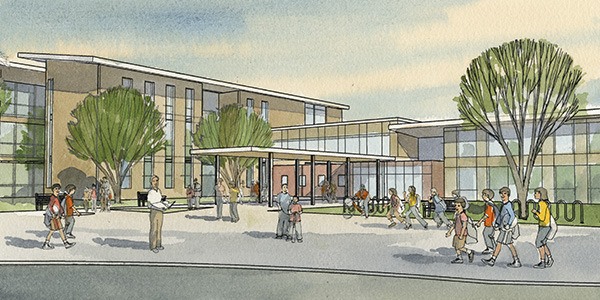
In other parts of the district, the bond would pay for rebuilding and enlarging Juanita High School (JHS) and Peter Kirk Elementary School in Kirkland as well as Margaret Mead Elementary School in Sammamish. The bond would also complete capital projects throughout the district for Americans with Disabilities Act and/or Title IX compliance.
And while most of the projects on the bond will be happening in the Redmond learning community, Pierce said there is growth everywhere. If it is not in the form of new development, she said, it is in the form of turnover as people are moving out of established neighborhoods and new families are moving into those homes.
A SPACE/AGE CHALLENGE

“The growth itself is not the challenge,” Pierce said.
The challenge the district is facing, she said, is crowded schools, not enough classrooms and aging facilities. By next year, 14 percent of LWSD’s classrooms will be in 168 portables. This is equal to seven elementary schools. Pierce said the portables were meant to be temporary and an alternative to a re-boundary — something the district has also done a number of times in the last few years — to accommodate growth in a neighborhood.
While there is already a big need for more brick-and-mortar classrooms, that need will grow as the state’s ruling in the McCleary case to fully fund public education goes into effect. Pierce said part of that ruling includes the state funding all-day kindergarten and reduced classroom sizes for grades K-3. All of this means more classrooms, which would not be funded by the state. The state would only fund staffing for these additional classes.
In addition to the need for more classrooms, a number of LWSD schools are also getting old and are showing their age. Pierce said the bond would address this and growth as updated buildings on the list would also be enlarged to accommodate a larger student population.
“We want to build buildings that last 50, 60 years,” Pierce said.
A PLAN FORMED BY COMMUNITY MEMBERS
Pierce said the bond measure will not increase the tax rate, maintaining the rate from 2015 of $3.30 for $1,000 assessed value. In addition, LWSD bonds and levies from previous years are being paid off so the new bond will be replacing these measures.
The cost of projects listed in the April bond total $429 million, but the district would receive $21 million in state construction assistance program funding as well as $10 million in school impact fees, bringing the total down to the previously mentioned $398 million.
In addition to next month’s bond measure, the district has three more potential bonds on tap for 2018, 2022 and 2026 for $288 million, $278 million and $207 million, respectively. These additional bonds would go toward additional capital projects to continue the district’s work to accommodate the area’s growth.
According to the LWSD website, none of these bond measures will raise the tax rate, either.
Pierce said all of these are part of a long-term plan developed by a 63-member, citizen-based Long Term Facility Task Force the district formed. The task force spent about a year analyzing the issues, seeking feedback from the community and developing recommendations for the district’s facility needs.
Pierce said the LWSD board of director unanimously approved the task force’s recommendations.
SEEING THE NEED FIRSTHAND
For Redmond Ridge resident, Beth Sigall, the bond is needed.
With two children attending Redmond High School and one at Rosa Parks Elementary School — the latter of which has had ongoing overcrowding issues — she has seen the growing population and need for additional space.
As a parent who volunteers in her children’s schools, she has seen evidence of overcrowding during school assemblies, in the lunch room and by the number of portable classrooms on campus.
Sigall also serves on the board for the LWSD PTSA council, so she has seen the issues other learning communities are facing.
“Our schools are crowded and we’re growing really fast,” she said. “We need more classrooms.”
In the Redmond learning community, Sigall said at Dickinson, not only are there a lot of portables on campus, but some of the portables are also in bad condition and either need to be replaced or repaired or new classrooms need to be built.
In Kirkland, she said JHS does not meet the needs of the students or facility as the building has a lot of open areas, but not a lot of classrooms. The school is also in need of more restrooms as there are often lines for the facilities, Sigall added.
And at Mead Elementary in Sammamish, Sigall said the lunch carts and employees who serve students hot lunch are now stationed outside to make more space indoors. In addition to dealing with bad weather at times, she said the school has now put up netting around the area as crows were beginning to fly in and steal food.
Sigall said adults would not put up with these types of conditions at their workplaces for five minutes, but the students and staff at these schools have and do.
“It’s just not a sustainable way to run a school,” she said. “We shouldn’t have to expect that from the kids or the adults.”
A VULNERABILITY
While district officials say the bond won’t raise tax rates, former Redmond mayor Rosemarie Ives said it does not mean what people pay in schools taxes would stay the same. She said assessed property values are increasing, so while the tax rate may remain the same, people can still end up paying more.
In addition, another area of concern for Ives is the district’s proposal to refurbish the ORSCC in downtown Redmond to become a preschool center.
While the ORSCC is district property, LWSD has leased the building to the City of Redmond on a 40-year lease. Ives said the lease, which she negotiated while she was mayor, has reached about year 18.
She said as a community center, ORSCC is used regularly and serves thousands of people every year.
“That’s a wonderful facility,” she said. “It’s such a true community center.”
The programming at ORSCC ranges from exercise classes to day camps. The building is also home to the Redmond Historical Society.
Ives said if the bond is approved and the ORSCC becomes a preschool center for the district, that will limit the type of additional programming in the facility as there are more restrictions that come with preschools regarding other uses in a building.
“What will happen to all that programming?” Ives asked about the current offerings at the ORSCC.
While this is a point of concern for her, she does acknowledge the space issues LWSD is facing.
“I can’t blame the school district,” Ives said.
According to the district website, this project would provide 10 preschool classrooms, a gymnasium and cafeteria/commons.
Ives is also concerned with the fact that a preschool center would mean busing students from outside communities into Redmond.
“This is a vulnerability,” she said about the proposed ORSCC project, saying this could be a reason people would vote “no” on the bond.
When asked about the city’s plans in the case that the bond is passed and the ORSCC is slated for the preschool conversion, City Council president Hank Margeson said city staff has already begun to plan for the possibility of the lease being terminated. He said the city values its ongoing partnership with the district and that the long-term lease for the ORSCC has provided many years of recreation programming for the community.
“We recognize, however, that community space and program needs for both education and recreation have been changing,” Margeson said. “Further, when the increased level of maintenance needed at the 44-year old pool at Hartman Park — for which council just recently approved ‘life support’ funding — is factored in, the work that began in 2009 on concepts, siting and funding a community and aquatics center, has increased focus as we strive to ensure that Redmond residents continue to receive the quality services they expect and desire.”